Investment companies block access to tens of thousands of acres in Wahkiakum, Pacific counties
Published 2:27 pm Monday, March 9, 2026
ELOCHOMAN RIVER VALLEY — Investment companies have whittled away the land hunters can use in Wahkiakum and Pacific counties.
Access to tens of thousands of acres of locally treasured, longtime hunting grounds is now blocked because a new generation of private landowners won’t offer access.
The landowners are often investment companies, not based in the region or even the country. Not only is hunting off limits on their lands, they also often block access to adjacent properties that are state-owned — and therefore should be public — or adjacent privately owned property that still allows free hunting.
Steve Ogden, an assistant manager for land operations at Washington Department of Natural Resources, acknowledged the problem, but said the agency’s hands are tied — private landowners can’t be forced to allow people on their land.
The companies’ land restrictions have begun to erase generations-old family traditions, especially among the working class, and reduce access to affordable, healthy foods, like elk, in Wahkiakum — Washington’s second-poorest county.
Timber giants Crown Zellerbach and Weyerhaeuser owned nearly the whole forest when longtime Wahkiakum County Commissioner Dan Cothren was growing up.
“It was just totally different than it is now,” said the 72-year-old. “Our entertainment was jump in a rig, take off in the back woods, and you could travel and go fish, go hunt — there were no gates.”
Cothren started cutting down trees for logging operations straight out of high school, following in his father’s and grandfather’s footsteps.
The companies employed hundreds of people around the area — and they allowed employees first access to the forests during hunting season.
Elochoman Mainline
The key to that access was — and still is — a road known as the Elochoman Mainline, or “The 500,” that runs along the Elochoman River north into Lewis County. The road is the only way to access tens of thousands of acres of prime logging and hunting land from Wahkiakum County.
But over Cothren’s nearly four decades in logging, ownership and access has changed dramatically.
Corporate consolidation took off as Wall Street transformed timberland from a construction commodity into an investment vehicle for global financial giants to diversify their multibillion-dollar asset portfolios.
Crown was bought out in a 1985 corporate takeover by Sir James Michael Goldsmith, a French-British politician, financier and member of a German noble family.
In the following decades, land in the valley and around the region was cut up and sold off countless times.
And with those sales, Cothren, and other generational hunters saw access slowly striped away.
By the 1990s, roads Cothren had grown up on were increasingly blocked off with private gates.
“When the gates went in, maybe they’d open up for two weeks for access, and then they’d shut it off,” he said while driving The 500, late last summer. “And when these different groups came in and bought it, they’d all have different rules.”
Some companies began to charge for hunting land access. Hunting — which many families in the poor county used to put food on the table — started to turn into a hobby for the haves, not a means of survival for the have-nots.
Access denied
Hunters say the problems were exacerbated when a new company came to town: American Forest Management, which oversees 5.7 million acres of forest land in the Americas for its owners, who are often not local or even living in the country.
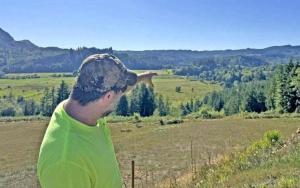
When Wahkiakum County native Shawn Jacob, 54, tried to reach a popular hunting spot along The 500 a few years back, he found an American Forest Management gate completely blocking access.
For nearly two decades Jacob hunted in the Upper Elochoman River Valley, including this site past an old Crown camp, near where Cothren said he lived while his family worked for the company.
“Came up to go in and the sign was up,” Jacob recalled. “‘No trespassing?’ Why can’t I go in there?”
He called Cothren to ask how American Forest Management could lock away the county’s hallmark hunting grounds — also blocking off access to tens of thousands of acres of state and private land hunters were still allowed to use.
He wasn’t the only one with that question.
In addition to his role as a longtime commissioner, Cothren also works as a jack-of-all-trades contractor for American Forest Management, enforcing the company’s policies and dealing with the public’s complaints firsthand.
“I even told the forester, I said, ‘Why don’t you get me a bulletproof vest?’” Cothren recalled saying to an American Forest Management staffer because of the number of angry calls about the restricted access.
Marisa Bass is an American Forest Management regional manager, making her responsible for about 255,000 acres of that land around Washington and Oregon.
“By and large, we follow the direction of our clients,” Bass said about who decides if hunters can access timberland. “It is their land. We just manage it.”
Bass said two clients currently allow access to the land for now: the nonprofit The Conservation Fund and the company Clover Forest LLC.
She declined to name other American Forest Management clients in Wahkiakum and Pacific counties. She also declined to say which lands hunters can or can’t access, or how access has changed over the last decades.
Tens of thousands of acres blocked off
However, The Daily News talked with more than a dozen hunters and county commissioners around the counties, looked at property ownership records and drove hundreds of miles to find tens of thousands of acres blocked off by American Forest Management.
That includes hundreds of acres of state land in Pacific County’s Bear River area, as well as thousands of acres of surrounding land owned by Mid-Valley Resources, a registered trade name of Hampton Lumber, state records show. Hampton allows free hunting access on its lands.
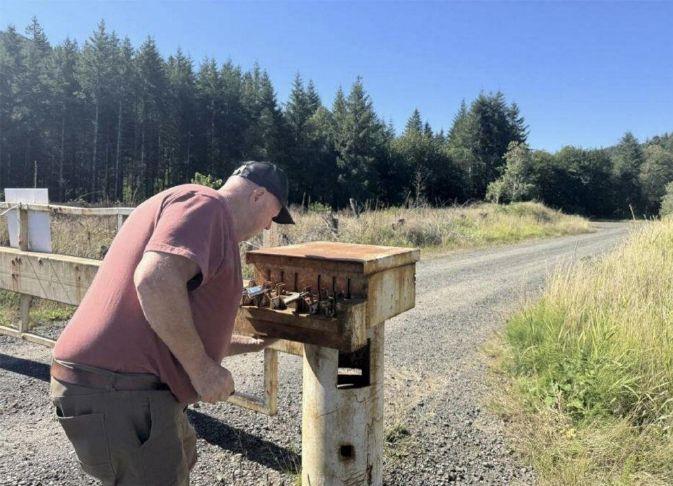
But access to all that is blocked off by American Forest Management gates along State Route 401 that warn against trespassing, The Daily News confirmed in person in October.
A reporter asked Bass about hunters’ frustrations that they’ve been cut off from their traditional hunting grounds and that neither American Forest Management nor the web of land-owners would sit down and talk to them about the problem.
But she declined to comment and ended an interview after the question.
The lack of communication and land restrictions aren’t sitting well with locals.
“Not saying I support it, but a lot of people felt upset enough that they vocalized threats — that have come to nothing, no fruition — but they had mentioned just burning it all down,” said Gabe Bergman, a Wahkiakum County gunsmith, about privately owned, inaccessible timberland.
Cothren said he’s also heard threats, including those who want to cut the locks off private gates.
Shawn Jacob, who lives in the county to hunt and contributes to its economy with his boat and engine repair shop, said he’s already seen people move, and is considering leaving himself.
“That’s how it works,” he said. “Take it away, they’re still going to hunt, they’re still going to fish — they’re just going to do it somewhere else.”