German royalty controls 7% of Wahkiakum County; what does that mean for hunting access?
Published 4:40 pm Monday, March 9, 2026
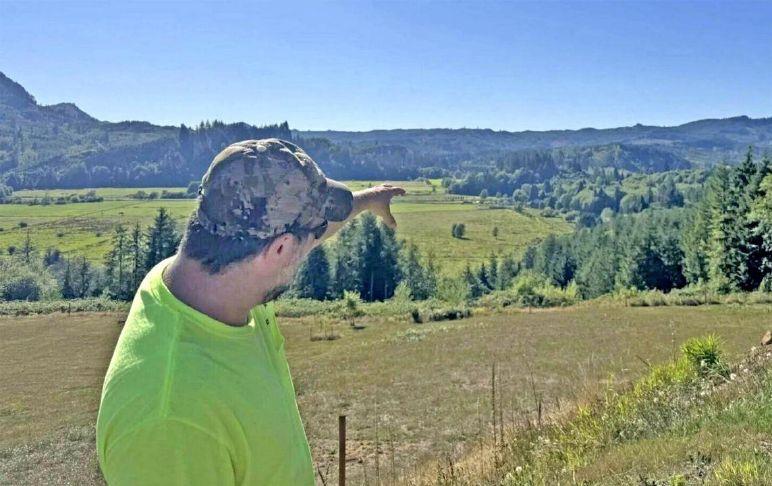
ELOCHOMAN RIVER VALLEY — An investment company co-founded by a 21st -century German prince is joining other timber industry goliaths in gobbling up and shutting down access to hunting land in Wahkiakum and Pacific counties.
The change comes as Pacific Northwest timberland values are rising, making the region attractive to European investors who value the cheap, privately owned land — unlike in much of Europe.
In 2024 alone, companies affiliated with Constantin Prinz zu Salm-Salm (AKA Prince Constantin) spent more than $100 million on roughly 12,000 acres of timberland in Wahkiakum County, records show, or about 7.3% of the county’s total land.
The conflict over the counties’ hunting land highlights the growing tension between a global elite who use timberlands to balance investment portfolios worth hundreds of millions of dollars, and the local, lower-to-middle-class hunters impacted by their investment strategies — including possible misdemeanors when accessing land on which previous generations hunted.
American Forest Management is a timberland management giant, filling the need for on-the-ground hands to care for forests that are increasingly owned by distant financial giants.
Hunting is banned on much of the land the company manages across Wahkiakum and Pacific counties.
A regional manager for the company told a reporter that American Forest Management enforces those owners’ policies, no matter the rules.
Trespassing penalties
Brent Mahitka, 52, learned that the hard way. He has lived and hunted in the region for about 30 years and said he has paid Weyerhaeuser hundreds of dollars to hunt a prime location in Pacific County.
But Mahitka said he accidentally ran afoul of the patchwork ownership regime in November, when he realized an elk he shot was actually about 150 yards into American Forest Management-managed land.
He said he immediately called Wahkiakum County Commissioner Dan Cothren, who works for American Forest Management, to report his mistake.
Still, Wahkiakum County District Court records show Mahitka faced a $2,000 ticket and 90-day county jail sentence.
Records show Washington Department of Fish and Wildlife officers also considered charging him with “hunting while trespassing,” a more serious misdemeanor that can result in one year in county jail, a $1,000 fine and an automatic two-year hunting license revocation.
In the end, he was fined $500.
Nine other people received elk violations from WDFW in 2025 around Wahkiakum and Pacific counties, according to agency spokesperson Becky Elder. Those violation numbers have hovered around that number for the last five years, during which time two incidents involved American Forest Management-controlled land, Elder added.
The agency did not answer how many incidents led to jail time or hunting while trespassing charges.
County records show the land Mahitka accidentally crossed into is owned by VGI Forest Lewis & Clark, one of Prince Constantin of Salm-Salm’s companies.
Rumors that some of the American Forest Management land was actually internationally owned added insult to injury for some in the county, though no one a reporter talked to said they knew for sure who owned the land.
However, records reveal around the two counties, VGI Forest Lewis & Clark often owns lowlands that allow the company to block access to neighboring state and private lands hunters are allowed to use.
All told, the company and a network of affiliated shell companies own about 25,000 acres of forestland around Wahkiakum and Pacific counties, an analysis of property records shows. That includes in the Elochoman River Valley, where they own more than 10,000 key acres.
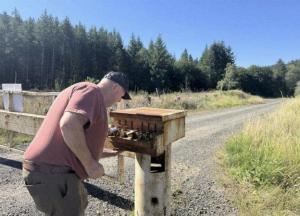
The ownership blocks off access to thousands of acres of free-to-use hunting lands owned by the state, as well as a company called Manulife and the nonprofit The Conservation Fund — unless hunters have the stamina to walk miles up the American Forest Management easement before they step off The 500 to then walk to approved hunting grounds.
Steve Ogden, an assistant manager for land operations at Washington Department of Natural Resources, confirmed that thousands of acres of state land around the area are indeed currently inaccessible.
Records from the Washington Department of Revenue reveal VGI Forest Lewis & Clark LLC is run by senior leadership at German investment giants Salm Schulenburg LLC and Viessmann Generations Group.
Salm Schulenburg was co-founded in 2014 by Constantin Freiherr von Wendt and Constantin Prinz zu Salm-Salm, along with the Schulenburg family.
The Schulenburg family is a storied German noble family, as is the Wendt family. Freiherr means “baron,” which is a title within German nobility. And Constantin Prinz zu Salm-Salm is a German Prince living in Wallhausen Castle outside Frankfurt, according to Salm-Salm & Partner.
Bolko Graf von der Schulenburg leads U.S. operations for the company. His title “Graf” translates to “count,” a hereditary status in German nobility.
Cultural differences
Asked about the optics of a company run by foreign nobility buying huge swatches of timberland in Washington’s second poorest county, then ending hunting access, Schulenburg said the company’s ties to German nobility are positive.
“In Germany, actually, investors are quite happy about it,” he said, “because they know that through our lineage over — not only decades, but centuries — our families have managed and owned forests and agriculture.”
He added that European influence may still benefit Wahkiakum and Pacific counties because his investors are generally more open to free public access on private land. That right is enshrined in law across much of Europe in a doctrine known as “freedom to roam” and “everyone’s right.”
“They actually are surprised when I tell them private land in the U.S. is actually that: private,” he said. “You can block it off and tell people, ‘No trespassing, this is my land, nobody enters’ — that is a foreign concept to the Europeans.”
That ability also allows Schulenburg to moderate some risks, such as human-caused accidental fires, hunting accidents and illegal dumping. Other factors that drew the companies to the region include good soils, lower fire risk compared to east of the Cascades, and land prices that are far less expensive than back home, Schulenburg said.
“The returns on timberland are better here in the U.S.,” he said. “The land in Europe has gotten so expensive, it almost is (that) you have to inherit the land; you cannot buy the land anymore.”
Huge investments
Those conditions have led the company to facilitate huge investments from ultra-wealthy Europeans.
County property transfer records show a handful of limited liability companies — set up to facilitate land purchases for European mega-investors — spent about $114 million on lands in Wahkiakum County across two purchases in 2024 alone.
One of those was roughly 8,000 acres for about $85 million. Another deal was nearly 4,300 acres for about $29 million.
While access is currently shut down to the companies’ properties around the counties, Schulenburg said the company has not yet finalized the land’s access policy after the purchases, instead focusing on timber harvests.
He asked for patience.
“If I have a $10,000-an-acre harvest and a hunting lease might be a dollar or two an acre, that is sort of the scale we’re dealing with,” he said, “so it’s very easy then to prioritize where my time ought to be spent.”
Cothren’s efforts to negotiate public access with American Forest Management have been unsuccessful so far.
Schulenburg said he is open to discussions, adding he leans toward eventually opening the land up for large-scale hunting leases where a group of insured hunters pays thousands for exclusive access to a large bloc of land.
Schulenburg advised people to be diplomatic, especially to his company’s land managers: “Tone is everything; if you talk to someone nicely, you usually get better results.”
But ultimately, he said, change is coming to the whole region no matter what, as land values continue to rise.
“These changes will come. I don’t think just because the public had been able to use the land for a long time as they please,” he said. “Basically, I think that is a change that is unstoppable.”