Analysis: Part 2 Willapa ecosystem shocks: One thing after another for our bay
Published 12:00 pm Sunday, March 1, 2026
Throughout its “geologically young” 4,500- to 5,000-year history, Willapa Bay has endured many dynamic changes to its ecosystem. Approximately every 300 to 600 years, Cascadia Subduction Zone earthquakes cause the bay floor to drop suddenly by several feet. Subsequent tsunamis scour the bay bottom and reset Willapa Bay’s ecosystem.
Cascadia events may have the highest overall impact on Willapa Bay’s ecosystem, but they are cyclical and ultimately recoverable. “Unrecoverable” ecosystem changes to Willapa Bay weren’t known to occur until after Russian, British, U.S. and First Nation peoples began commercial exploitation of the region’s natural resources in the late 1700s.
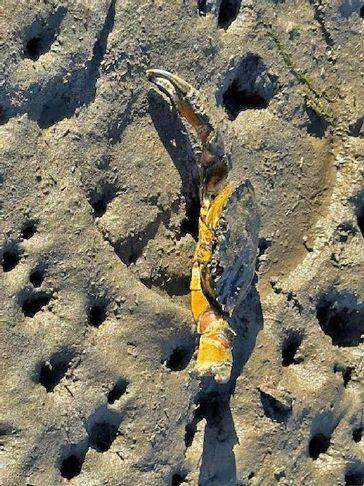
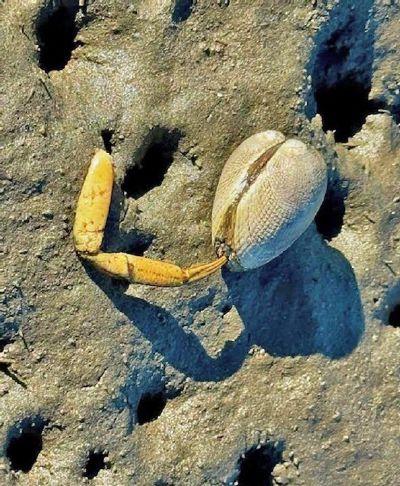
Since then, there has been one collapse after another of Willapa Bay’s ecosystem. The onoging European green crab (EGC) crisis is one of many “end of an era” events for the bay. The damming of the Columbia River, devastation to sturgeon populations, splash-damming of tributary streams, and loss of the native oyster beds’ infrastructure are notable events signifying the end of an era.
The Columbia River is the largest and most powerful river on the West Coast of North America. Willapa Bay’s ecosystem is closely connected to the Columbia River. Before major dam construction, the steep altitude drop of the Columbia River resulted in very high velocities, which drove rapid transport of water to the sea. In spring, this river’s effect on Willapa Bay grew as it surged with massive spring floods created from melting snow. The river frequently brought nutrient-rich, sediment-laden, low-salinity freshwater almost directly into Willapa Bay. Many species freely traveled back and forth from the Columbia River to Willapa Bay.
For better or worse, the Columbia River has transformed from a river of life into a river of commerce. Dynamic changes to the Columbia dynamically affects Willapa Bay. Dams transformed the Columbia River’s high-velocity, steep-gradient system into a series of slow-moving, deep reservoirs, drastically reducing natural water speed. Dams like Grand Coulee and Bonneville now hold water back in the spring for power and release it in the winter.
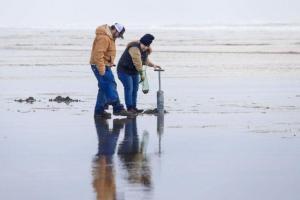
This has smoothed out the “pulses” of freshwater reaching Willapa Bay and eliminated the vast changes of salinity and nutrients associated with these pulses. Lots of sediment that used to travel to Willapa Bay is now trapped behind dams. It is estimated that the amount of sand reaching the mouth of the Columbia has dropped by over 60% since the damming began. Prior to the damming of the Columbia, a much higher percentage of Willapa Bay’s tide flats were sand-covered. Razor clams were known to live in this sand as far south as halfway between Oysterville and Nahcotta.
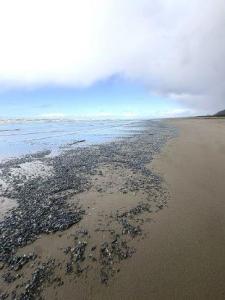
Washaway Beach, located at the mouth of Willapa Bay, is considered the fastest eroding shoreline on the U.S. West Coast and one of the fastest in the country. This, too, is most likely due to the Columbia becoming a river of commerce. Taming the river with sediment-trapping dams, jetties and dredging have fundamentally starved the North Cove sand spit of the sediment it needs to replenish itself.
Without this sediment, the sand spit has all but disappeared and no longer stops powerful southern storms from breaking directly into Washaway Beach. This has caused the loss of 2,000 acres of land since the early 1900s, with erosion rates exceeding 100 feet per year. Between 1984 and 2016, 537 parcels covering over 2,000 acres were lost. An additional 547 acres are projected to vanish by 2060.
Dam destruction
While logging old-growth forests from the 1880s to the 1950s, logging companies built temporary wooden “splash dams” across narrow streams to create large reservoirs. Old-growth trees were cut and stored in the reservoirs formed behind these dams. These reservoirs often held thousands of logs.
These dams were often opened with dynamite, which released a massive wall of water and timber that “splashed” downstream to mills. Repeated torrents from various splash dams being built in the same stream altered the sediment dynamics of the bay. In the short term, they caused dramatic erosion of stream banks; in the long term, the loss of natural “sediment traps” (like logjams) in the hills contributed to Willapa Bay becoming much more muddy and silting then it was at the time of first European contact. Thousands of acres previously covered with sand or oyster reefs in Willapa Bay have become deep, silty mud — unsuitable habitat for abalone, sea urchins, oysters and clams.
Dams on the Columbia and Sacramento rivers block and degrade historical sturgeon spawning grounds. This directly reduces the number of sturgeon migrating into Willapa Bay each summer to feed on burrowing shrimp. Historically robust populations of green sturgeon controlled burrowing shrimp populations. Ghost shrimp represented 51% of the biomass in the stomachs of green sturgeon sampled in Willapa Bay according to a study by Brett Dumbauld et al. (2008) published in the Environmental Biology of Fishes.
Out-of-control burrowing shrimp can quickly transform eel grass beds that support a variety of species into a monoculture of burrowing shrimp. The devastating effects that these burrowing shrimp have on commercial oyster and clam beds have been widely reported.
Native species fade away
Green sturgeon are currently listed as threatened. In 1892, sturgeon harvest peaked at 5.5 million in the Columbia River basin, which includes Willapa Bay. Within five years, this sturgeon fishery had a 98% collapse due to unregulated overfishing. Green sturgeon females don’t start reproducing until their 16th to 20th year. Recovery of green sturgeon populations is not an immediate fix to this issue, but potentially might be a tremendous help in bringing native burrowing shrimp populations into balance.
At the time of European and American contact, native oysters in Willapa Bay numbered in the billions. Prolific native oyster beds occupied as much as 27% of the bay and were a dominant keystone species. Between 1851 and 1915, it is estimated that more than five billion individual native oysters were exported from Willapa Bay to markets like San Francisco, with little or no reseeding of native oysters.
Today, the native oyster is relatively rare in Willapa Bay. It is considered a “species of concern.” The ecosystem that existed on the reef infrastructure created by native oysters is gone. Willapa Bay is now dominated by the non-native Pacific oyster.
Invasives
Many invasive species “hitchhiked” a trip into Willapa Bay when the Pacific oyster was introduced into its ecosystem. Several of these have been highly damaging. Japanese eelgrass (also known as Japonica) and the Japanese mud snail have drastically altered the habitat of thousands of acres of Willapa Bay.
The Japanese mud snail reaches incredible densities on the mudflats, outcompeting native snails and altering the biofilm that other species rely on for food. Japonica covers previously uncovered biofilm, restricts water flow and kills native fish. This happens when these and other native species get trapped in thick Japonica mats on outgoing tides and subsequently die of exposure.
Another “hitchhiker” species, the Japanese oyster drill, is a predatory snail that uses its radula (a sandpaper-like tongue) to drill holes through clam, mussel and oyster shells. The Japanese oyster drills are much more efficient predators than native drills. They are especially lethal to the small, thinly shelled native oysters.
In contrast to the Pacific Oyster, the EGC is much more unlikely to bring along “hitchhikers.” The EGC may actually devastate invasive species that accompanied the Pacific oyster to Willapa Bay, as well as native species. Unfortunately, one of these non-native species is the beloved Manila littleneck clam. The Manila clam is a rare accidental introduction of a non-native species that has become a commercial success. After arriving with oyster seed imported from Japan, Manila clams have become the most widely harvested commercial clam on the West Coast.
Decades ago, Willapa Bay was on the edge of another collapse to its existing ecosystem due to the invasive cord grass spartina. This was despite years of expenditure of large amounts of money and effort by shellfish growers — including this writer — and state and county governments. Despite intense control efforts, spartina was on the verge of dominating all of intertidal Willapa Bay. The majority of Willapa Bay was well on its way to becoming one continuous spartina meadow.
Realizing the effect this would have had on migratory birds and other native species, the federal government got involved in a decisive manner. It collaborated with the Washington State Department of Agriculture (WSDA) to use helicopters to apply the herbicide imazapyr to control large meadows of spartina. This turned the tide in spartina control. Continued efforts of local, state, federal and tribal governments have significantly reduced spartina levels. There has been a well over 99% reduction of the infestation of spartina in Willapa Bay since the early 2000s. Perhaps an immense federal response to EGC similar to its response to spartina is the only real hope to control EGC in Willapa Bay.
Incompetence or bad luck?
The state government has spent over $20 million on management and eradication efforts since the 2022 EGC emergency proclamation. EGC are now more likely than ever to become the dominant crab species in Willapa Bay.
“I don’t know if the dire situation we are in now is because of complete incompetence, insubordination, bad luck or what, but in the four years since WDFW was ordered to, and funded to stop the spread of European green crab, the population in Willapa Bay has grown exponentially and now there are millions of them,” Warren Cowell commented on his Green Crab Disaster Facebook page.
It has taken several generations for Willapa Bay to become dramatically altered by individuals, government and industries. Controlling the EGC invasion could be an important and inspiring step toward reversing this trend. When generations of citizens, businesses and government work together to facilitate circumstances that allow the bay to heal itself, the tide of degradation will turn. Willapa Bay’s ecosystem will ride a tide of revival, moving it ever closer to the pristine state in which humans found it.