Washington, Oregon set December heat records
Published 3:05 pm Sunday, January 18, 2026
The U.S. had above-average temperatures from coast-to-coast in 2025, according to the National Centers for Environmental Information. Washington came close to setting a heat record for the year. (Graphic courtesy of National Oceanic and Atmospheric Administration)
December was the warmest on record in Oregon, Washington and California, according to the National Centers for Environmental Information.
The warm month capped a warm year. Washington had its second-warmest year since record-keeping began in 1895. Oregon had its third-warmest year and California its fifth warmest.
Local records
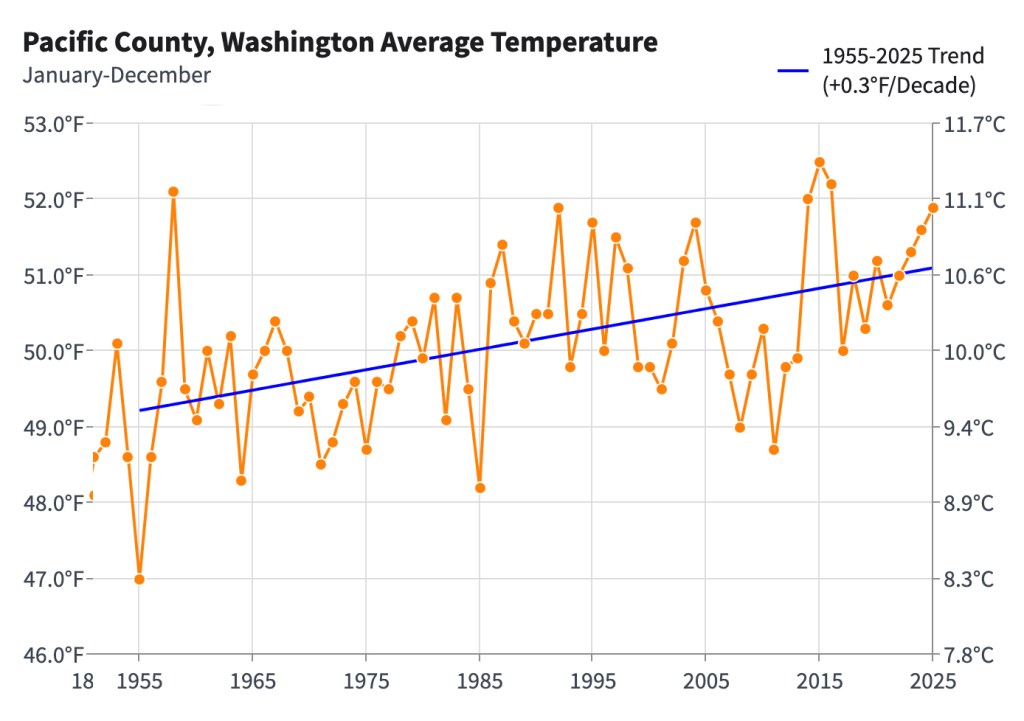
December’s average temperatures was 45.9°F in Pacific County, the warmest on record.
Pacific County recorded its fifth warmest year on record in 2025, tying with 1992, according to the National Centers for Environmental Information. The county’s average round-the-clock temperature was 51.9°F, compared to the warmest average of 52.5°F in 2015 in records going back to 1895.
The agency states that, overall, the county received 80.87 inches of precipitation in 2025 — about 6.75 feet. This was drier than in 2024, when the total was 92.13 inches — 7.68 feet. The record was 122.33 inches — 10.2 feet — in 1950. The driest was 50.74 in 1929.
Unseasonably mild
The unseasonably mild December defied seasonal forecasts. A La Niña formed in the fall and that normally leads to below-average temperatures in the Northwest. This year, however, ocean temperatures were just barely cool enough to form a weak La Niña.
“That weak La Niña is behaving more like a weak or moderate strength El Niño,” Oregon State Climatologist Larry O’Neill said. “This is what we expect from climate change.”
Warm seas in the North Pacific and off the West Coast likely counteracted whatever force La Niña had, former Washington State Climatologist Nick Bond said. “I don’t think we can blame it or thank it for very much,” he said.
Weather patterns ushered in warm and moist air and combined with climate change to push up temperatures, Bond said. Average temperatures in Washington were nearly 7 degrees above normal.
“I don’t think the weather patterns that dominated December 2025 can be attributed to climate change,” he said. On the other hand, “there is, for sure, a background warming,” he said.
“We are getting warmer. We understand why. We don’t know exactly how it’s going to turn out,” Bond said.
Nationwide, the U.S. had its fourth-warmest year on record, according to a report released Jan. 13. Temperatures across the U.S. were above average, especially in the western one-third of the country. A region that takes in the West Coast and Rocky Mountain states had its hottest year on record.
Snowfall
La Niña years are typically snowy. But Oregon and Washington snowpacks are below average for mid-January, according to the Natural Resources Conservation Service. California’s snowpack on Jan. 13 was exactly 100% of average.
A La Niña typically has its most influence early in the calendar year, but the National Weather Service predicts this one will fade away soon.
“We shouldn’t completely discount the lingering effects of La Niña,” Bond said. “It could help cool us off a bit for the next month.”